
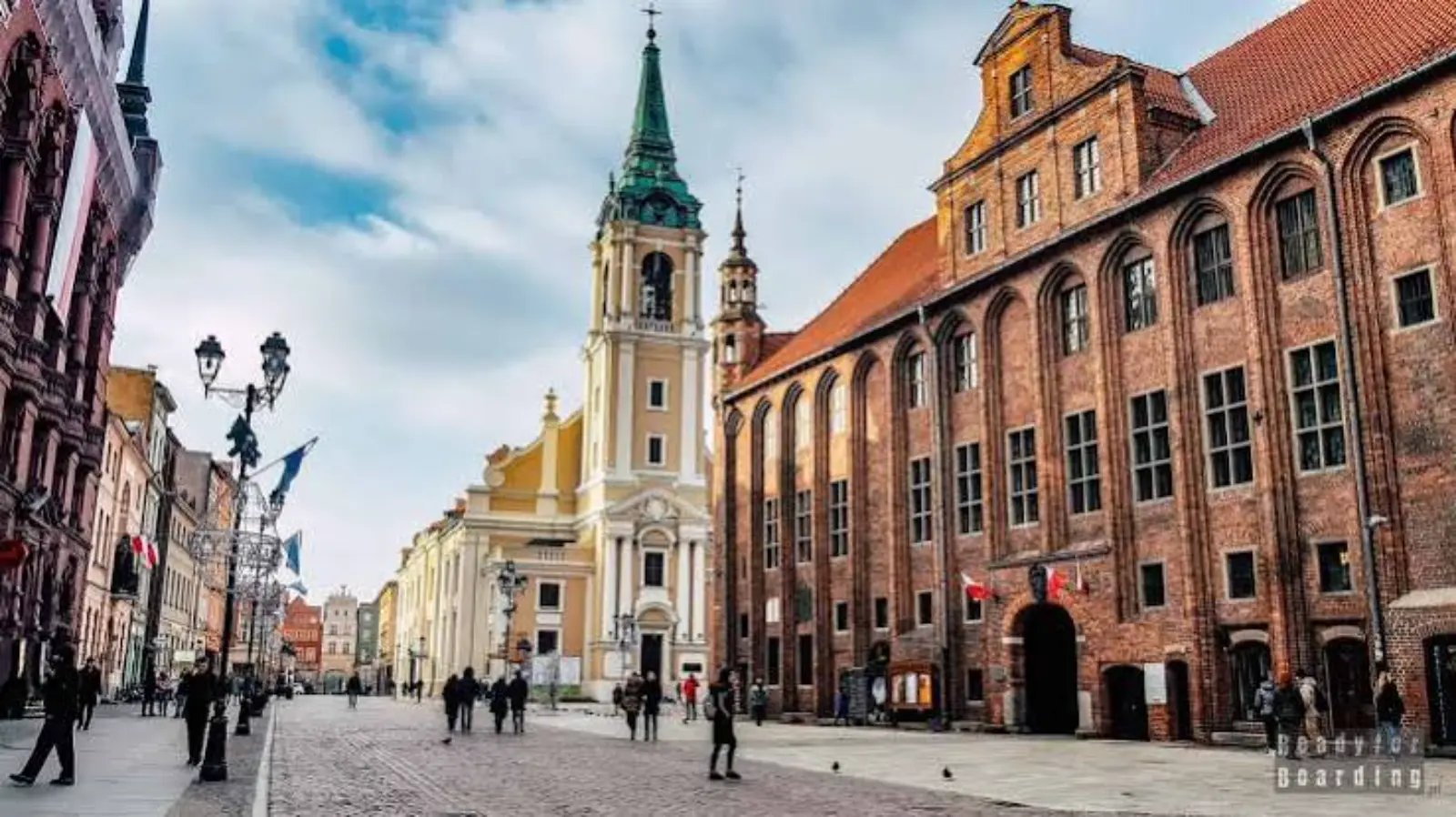
A compact UNESCO old town, riverside atmosphere, and the perfect leisurely weekend vibe. Slow travel through Toruń — the city of Copernicus and gingerbread.
Why Toruń, differently
Toruń is one of the few Polish cities that survived the ravages of war, preserving almost entirely its medieval urban layout. The Old Town is inscribed on the UNESCO list — not for individual monuments, but for its **coherent ensemble** of Gothic architecture, which managed to survive without major damage.
Slow travel through Toruń is a journey through time. Instead of racing from monument to monument, it is worth stopping at the Old Market Square at dawn, when the city is still asleep. Walk through empty alleys, listen to the silence, look at the details of brick facades. Toruń is a city that tastes best in slow motion.
What to see
Toruń splits into three main parts: the Old Town (with the Old Market Square and Town Hall), the New Town (with the New Market Square and churches), and the Vistula riverside (Philadelphia Boulevard). One or two days are enough to see it all.
Old Town and Old Market Square
- Old Market Square — the heart of Toruń, one of the most beautiful market squares in Poland. Surrounded by Gothic townhouses, with the Old Town Hall in the centre and a monument to Nicolaus Copernicus.
- Old Town Hall — one of the oldest and largest town halls in Poland. Today the seat of the District Museum, with a Gothic art gallery, coin collection and a hall with portraits of kings.
- Cathedral of St John — former church of St John the Baptist and St John the Evangelist, one of Toruń's most important monuments. The tower offers a panorama over the whole city. Inside, the famous Tuba Dei bell from 1500.
- Copernicus House — the townhouse where, by tradition, Nicolaus Copernicus was born. Today a museum dedicated to the astronomer, with an exhibition about his life and work.
- Leaning Tower — a medieval tower whose top deviates from vertical by over 1.5 metres. Legend says it was built by a Teutonic Knight who was then punished to stand in a corner — and since then the tower has been crooked.
- Raftsman Fountain — the famous fountain with a bronze sculpture of a raftsman and frogs, based on the legend of a raftsman who enchanted frogs so they wouldn't disturb residents' sleep.
New Town and riverside
- New Market Square — smaller and quieter than the Old Market Square, with St James's Church. Worth a look to see the less touristy face of Toruń.
- St James's Church — a monumental Gothic temple, one of the largest in Poland. The interior delights with a star vault and rich furnishings.
- Philadelphia Boulevard — a promenade on the Vistula, perfect for a walk at any time of day. From the boulevard you can see the panorama of the old town from the opposite riverbank.
- Teutonic Castle ruins — remains of a 13th-century castle, with preserved walls and a tower. Worth visiting with a guide — the history of this place is surprisingly dramatic.
Lesser-known corners
- Gingerbread Museum — one of the most interesting museums in Poland, where you can not only see the history of Toruń gingerbread-making but also bake a gingerbread yourself using a traditional recipe.
- Toruń Planetarium — one of the oldest planetariums in Poland, with astronomy shows and projections about Nicolaus Copernicus.
- Ethnographic Museum — in a former arsenal, with an exhibition of the region's folk culture. Less known but worth attention.
- House of Toruń Legends — an interactive museum where you can learn the city's most famous legends in an engaging form.
When to go
- April and May — the best time. The city blooms, fewer crowds, long days. Stable weather, but bring a jacket — it can be cool by the Vistula.
- September and October — second best. Warm days, autumn colours, fewer tourists.
- July and August — peak season. Market Square and cathedral crowded, but the city has summer energy. Come on a weekday.
- November and December — Christmas market on the Old Market Square (from late November). Beautiful but cold — bring warm clothes.
- Winter — January to March the city is quiet. Brick facades under snow look fairy-tale, and prices are lowest of the year.
Getting there
- By train: Toruń Główny is an important rail hub, with direct connections from Warsaw (~2.5 hours), Gdańsk (~2 hours), Poznań (~1.5 hours), Wrocław (~3.5 hours).
- By car: ~2.5 hours from Warsaw (S10 and A1), ~2 hours from Gdańsk (A1), ~2 hours from Poznań (S5 and S10), ~3.5 hours from Wrocław (S5 and S10).
- By bus: Flixbus and other operators serve most Polish cities.
- By plane: the nearest airport is Bydgoszcz (BZG), ~50 km from Toruń. From the airport to the centre ~1 hour by car.
Within the city, the centre is compact — most sights are within walking distance. Trams and buses are well developed, but for slow travel walking is enough.
How much time you need
A weekend (1–2 days) is the minimum — Old Market Square, Cathedral of St John, Philadelphia Boulevard and the Gingerbread Museum.
Two to three days is realistic for a first visit. One day for the Old Town, one for the New Town and museums, one for a trip around (Bierzgłowski Castle, Chełmno or Golub-Dobrzyń).
A week is overkill for Toruń alone, but sensible if you combine it with Bydgoszcz (~50 km), Chełmno (~40 km) and Golub-Dobrzyń Castle (~40 km).
What to eat and where to sleep
- Toruń gingerbread — the region's most recognisable product. Gingerbread with honey, spices and dried fruit, baked since the 13th century. Buy at a traditional gingerbread shop (Kopernik, Sowa).
- Katarzynki — small hexagonal gingerbreads, named after St Catherine, patron saint of Toruń.
- Kuyavian żur — sour rye soup with white sausage and egg. A Kuyavian cuisine classic.
- Toruń duck — roast duck with apples and marjoram, in the Toruń version with dried plums.
- Kuyavian pyzy — potato dumplings with meat filling, served with cracklings or mushroom sauce.
- Beer from local breweries — several craft breweries operate in Toruń (Browar Staromiejski, Jan Olbracht).
Accommodation: Old Town (most convenient, expensive, busy), New Town (quieter, cheaper, close to the centre), Vistula riverside (river views), districts outside the centre (Bydgoskie Przedmieście, Jakubskie Przedmieście — cheaper, but further). Toruń has several good hostels in the Old Town and guesthouses in side streets.
Practical tips
- Bookings — the Gingerbread Museum and Planetarium require online booking in season. Cathedral of St John — no booking, but tower access may have a queue.
- Guided tours — Toruń has a rich history worth learning with a guide. Especially the Teutonic Castle ruins and cathedral — without context, they lose half their charm.
- Crowds — Old Market Square and Cathedral of St John are crowded in season (May–September). Rise early (7–8 a.m.) and start sightseeing before the crowds.
- Gingerbread — buy authentic gingerbread in certified shops. Avoid stalls with cheap souvenirs — often industrial products, not craft.
- Philadelphia Boulevard — best views at sunset. Arrive 30 minutes early to grab a bench spot.
- Mobile signal — good throughout the centre. May fade in small alleys.
- Parking — the centre has a paid parking zone, spaces are hard to find. Leave the car at a P+R lot (e.g. by the station) and walk in.