A salt labyrinth 300 meters underground. St. Kinga's Chapel, lakes, and galleries carved since the 13th century. Slow travel through Wieliczka — Poland's most famous salt mine.
Why Wieliczka, differently
Wieliczka is one of the most extraordinary places in Poland — a labyrinth of galleries, chambers and chapels carved in salt over seven centuries. The mine operated continuously from the 13th century until 2007, and today is one of the most visited places in Poland. Inscribed on the UNESCO list in 1978 as one of the first sites in Poland.
Slow travel through Wieliczka means giving up haste. The standard tourist route is long (3 km underground, ~2 hours), and many tourists rush through it without reflection. Slow down, stop at St. Kinga's Chapel longer, look closely at the sculptures and salt chandeliers. Every meter of this route is a testimony to the work of generations of miners who, for centuries, extracted salt here while building an underground city.
What to see
The mine offers three main routes: the Tourist Route (most famous), the Miner's Route (interactive, with miners' work) and the Nature Route (for children and people with reduced mobility). Choose one or two.
Tourist Route (classic)
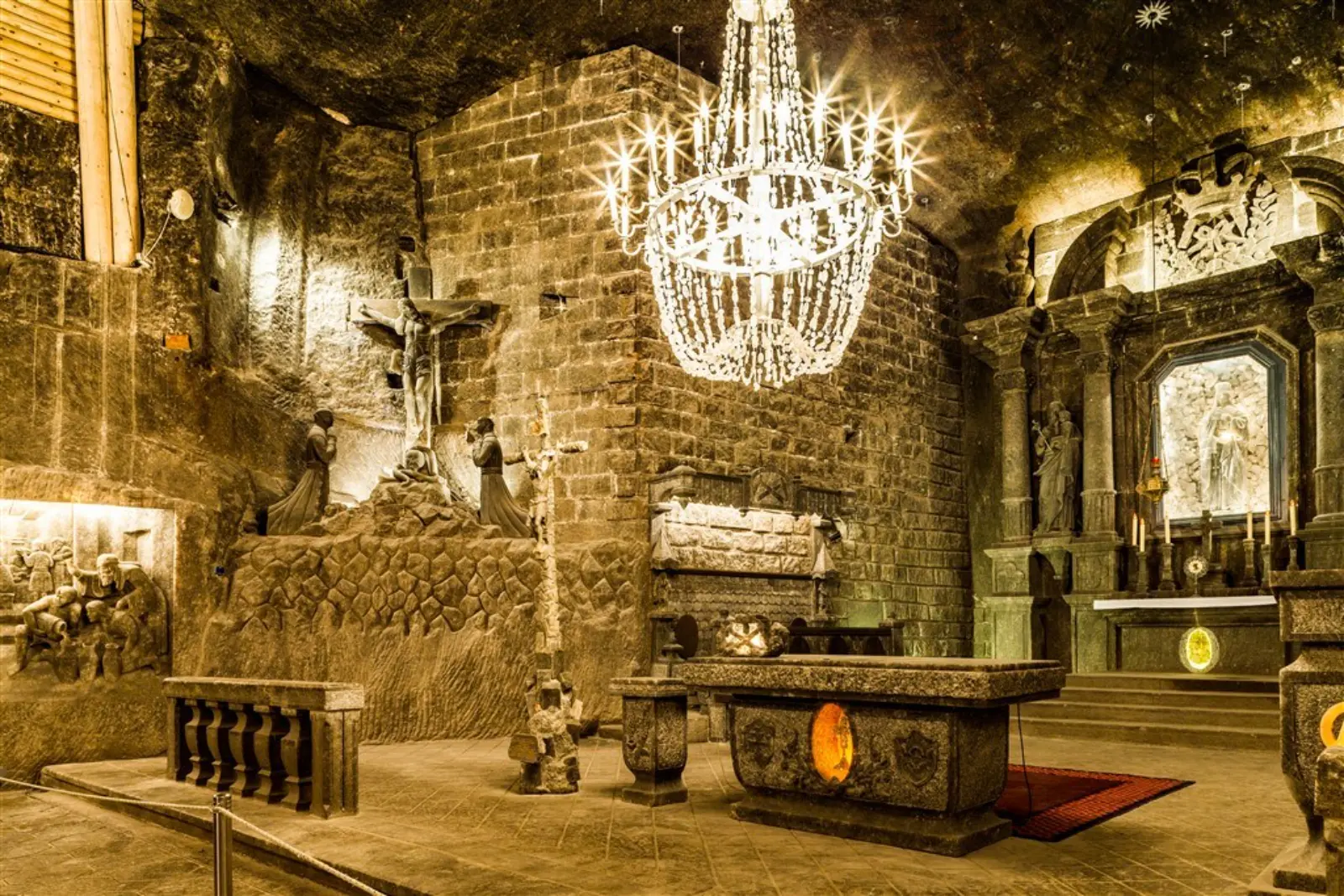
- St. Kinga's Chapel — the heart of the mine and the route's greatest attraction. Carved in a block of salt between 1896 and 1963, lit by chandeliers made of salt crystals. There are an altar, sculptures and reliefs — all of salt. A venue for concerts and wedding ceremonies.
- Janowice Chamber — one of the largest chambers on the route, with an exhibition about the mine's history and mining tools.
- Kazimierz the Great Chamber — a chamber named after the king who issued the mining statute for Wieliczka in 1368. Delights with crystal salt and sculptures.
- Brine lakes — two underground lakes in which light is reflected. The water is so salty that it is impossible to drown in it.
- Warsaw Chamber — a large chamber with an exhibition on the history of salt extraction in Poland. The tourist route ends here.
- Nicolaus Copernicus Chamber — commemorating the 500th anniversary of the astronomer's birth, honoring his visit to the mine (he reportedly visited in 1493).
Miner's Route (interactive)
- Miner's work — participants put on a helmet and overalls, receive tools and perform simple mining work (salt extraction, transport). An experience for those who want to feel the atmosphere of the 19th-century mine.
- Underground passages — the route leads through places unavailable to ordinary tourists, including narrow corridors and lower-ceiling chambers.
- Souvenir ticket — participants receive a lump of salt from the mine as a souvenir.
Nature Route (for children)
- Educational path — a route for children, the elderly and people with reduced mobility. Fewer stairs, more multimedia exhibits.
- Underground exhibitions — the geological history of Wieliczka, salt exhibits from various eras.
After touring
- Brine graduation tower — after surfacing, rest in the brine graduation tower in St. Kinga's Park. Inhaling mineral salts helps regenerate the body.
- Żupy Castle in Wieliczka — the mine's management seat since the 14th century, today a museum. Worth visiting to understand how the salt industry functioned in Poland.
- Museum of the Kraków Salt Works — a branch in the castle, an exhibition about the mine's history and salt mining.
When to go
- May and June — the best time. Fewer crowds, comfortable touring, stable weather. Book ahead.
- September and October — second best. Similar conditions to spring.
- July and August — peak season. Long queues at ticket offices, crowded routes, but all attractions open.
- November and December — fewer tourists, but the mine has a constant temperature (~14°C), so it is comfortable regardless of season.
- Winter — Wieliczka is less crowded in winter, and the mine has a constant temperature. Dress in layers — cold outside, warm underground.
Getting there
- By train: Wieliczka has a railway station on the Kraków–Wieliczka line (~30 minutes from Kraków Główny). The station is ~10 minutes' walk from the mine.
- By bus: numerous services from Kraków (from the Main Station or Main Square) — every 15–20 minutes. Travel time ~30 minutes.
- By car: ~25 minutes from Kraków (route 94), ~30 minutes from Kraków-Balice airport. Large car park at the mine, paid in season.
Wieliczka is just 15 km from Kraków — you can combine sightseeing of both in one trip.
How much time you need
Half a day (3–4 hours) is the minimum for touring the mine and walking around Wieliczka. Add time for rest at the graduation tower.
A full day lets you visit the mine, the Żupy Castle, the graduation tower and walk around Wieliczka's market square.
A weekend lets you combine Wieliczka with Kraków (a day trip) or with Bochnia (the second salt mine in the region).
What to eat and where to sleep
- Kraków obwarzanek — Kraków's symbol, also available in Wieliczka. Best fresh, with salt or poppy seeds.
- Pierogi — in restaurants in Wieliczka, especially around the market square.
- Duck with apples — a Lesser Poland classic, available in restaurants in the town.
- Kraków sausage — a ripening cold cut, inscribed on the EU protected products list.
- Specialty coffee — Wieliczka has several good cafés, especially around the market square.
- Beer from local breweries — several craft breweries in the Kraków region.
Accommodation: Wieliczka (several hotels and guesthouses in the centre, close to the mine), Kraków (~15 km, more options, but further), surroundings of Wieliczka (agritourism farms and guesthouses in smaller towns). Most tourists stay in Kraków and make a day trip to Wieliczka.
Practical tips
- Bookings — mine tickets are worth booking online well in advance (wieliczka-saltmine.com). The Tourist Route has a limited number of places, and interest is enormous throughout the year.
- Temperature — the mine has a constant temperature of ~14°C. Dress in layers, even in summer. The mine does not rent jackets.
- Shoes — the route involves many stairs (over 800) and uneven surfaces. Comfortable shoes are essential.
- Guided tours — mandatory (no self-guided tours). Guides speak various languages.
- Photography — allowed on the tourist route (no flash). In St. Kinga's Chapel, photography without restrictions.
- Lift — after touring you can return to the surface by lift (shaft) or stairs. The lift is faster but can be crowded.
- Signal — no signal in the mine (300 m underground). Inform loved ones you will be out of contact for ~3 hours.
- Parking — large car park at the mine, paid in season. Arrive early.