Post-industrial brick lofts, film history, and the vibrant pulse of Piotrkowska Street. Slow travel through Łódź — a city to understand, not just to see.
Why Łódź, differently
Łódź is one of the most unconventional cities in Poland. It has no Old Town like Kraków, no Hanseatic townhouses like Gdańsk. But it has something other cities don't — **true, unembellished industrial history**. Łódź is a city built by factories, and today it is rebuilding itself anew — without shame for its past, but with the ambition to be one of the most interesting cities in Poland.
Slow travel through Łódź is a journey through contrasts. On one hand, monumental palaces of industrialists (Izrael Poznański, Karol Scheibler); on the other, poor working-class districts where traces of former inequality are still visible. On one hand, film festivals and the Film School; on the other, neglected townhouses and excluded quarters. Łódź hides nothing — it shows everything, and that is its strength.
What to see
Łódź splits into Śródmieście (with Piotrkowska), Księży Młyn (factory housing estate), the former ghetto area (with Radegast), the EC1 area, and post-industrial districts (OFF Piotrkowska, Manufaktura).
Piotrkowska and the centre
- Piotrkowska Street — the most famous street in Łódź, a promenade ~4.2 km long. Craft shops, cafés, restaurants, murals, 19th-century townhouses. Worth walking the entire length — from Freedom Square to Independence Square.
- OFF Piotrkowska — a former Ramisch factory, today a creative centre with workshops, cafés, restaurants and galleries. A model example of adapting post-industrial space.
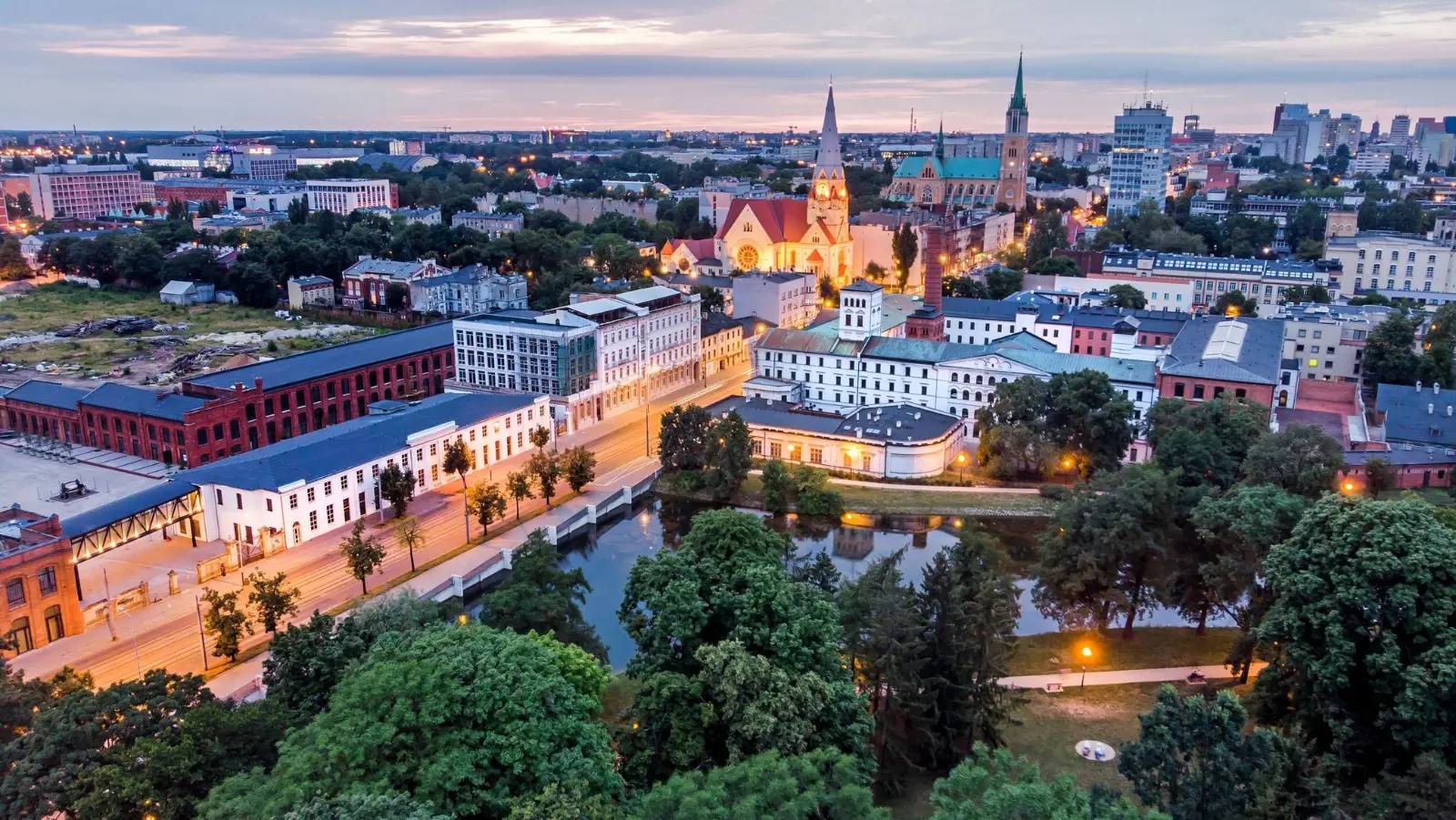
- Manufaktura — a former factory complex of Izrael Poznański, today a shopping and cultural centre. Factory Museum, Art Museum, cinema, numerous restaurants. Worth visiting at dusk, when the brick buildings are illuminated.
- Izrael Poznański Palace — one of the most beautiful industrialist palaces in Poland, today the Museum of the City of Łódź. Interiors delight with opulence — from the ballroom to private apartments.
- Geyer's White Factory — a former factory of Ludwik Geyer, today the Central Museum of Textiles. One of the most interesting textile collections in Europe.
Księży Młyn and factory districts
- Księży Młyn — a factory and housing complex of Karol Scheibler, one of the most interesting industrial complexes in Europe. Factory, workers' housing, school, hospital, church — all planned as a coherent whole. Worth walking through the estate and seeing how workers lived.
- Former Scheibler spinning mill — a monumental building, today adapted into lofts and offices. From the outside it still impresses with its scale.
- Źródliska Park — the oldest park in Łódź, surrounded by industrialist palaces. Worth combining a walk with a visit to Księży Młyn.
Museums and lesser-known corners
- Museum of Art (ms2) — one of the most important modern art collections in Poland. In a former factory building on Ogrodowa Street.
- Museum of Cinematography — in Karol Scheibler's palace, history of Polish cinema and the Łódź Film School. Worth it for fans of Wajda, Polański and Kieślowski.
- EC1 Łódź — a former power plant, today a science and technology centre, planetarium and cinema. Interactive exhibitions.
- Radegast Station — a former railway station from which Jews from the Łódź ghetto were deported to death camps during World War II. A memorial site, essential for understanding the history of Łódź.
- Jewish cemetery — the largest Jewish cemetery in Europe, with mausoleums of industrialists and graves of rabbis. Worth visiting with a guide.
- Łódź murals — over 100 murals throughout the city, including works by well-known world artists. Worth planning a walking route through the most interesting ones.
When to go
- April and May — the best time. The city blooms, fewer crowds, long days. Worth combining with a spring walk through the parks.
- September and October — second best. Autumn colours, warm evenings, fewer tourists.
- July and August — peak season. Piotrkowska crowded, but the city has summer energy. Come on a weekday.
- November and December — Christmas market on Piotrkowska (from late November). Beautiful but cold.
- Winter — Łódź in winter can be harsh, but museums are empty and prices low. Worth it for those who want to see the city without crowds.
Getting there
- By train: Łódź Fabryczna is a modern underground station, with direct connections from Warsaw (~1.5 hours), Kraków (~3 hours), Wrocław (~3 hours). Łódź Kaliska — for regional connections.
- By car: ~2 hours from Warsaw (A2), ~3 hours from Kraków (A1 and A2), ~3 hours from Wrocław (S8 and A2).
- By bus: Flixbus and other operators serve most Polish cities.
- By plane: Łódź-Lublinek airport (LCJ), ~6 km from the centre. Smaller airport, but with European connections.
Within the city, trams and buses are well developed. The centre (Piotrkowska) is compact and mostly pedestrian. For further districts (Księży Młyn, Manufaktura, EC1) it is worth taking a tram.
How much time you need
A weekend (2 days) is the minimum — Piotrkowska, OFF Piotrkowska, Manufaktura and Księży Młyn. Enough for a first impression.
Three days is realistic for a first visit. One day for Piotrkowska and the centre, one for Księży Młyn and factory districts, one for museums and EC1.
Four to five days lets you add Radegast Station, the Jewish cemetery, murals and several quiet afternoons in cafés. You can also make a trip to Film Łódź (Film School, Museum of Cinematography).
What to eat and where to sleep
- Pierogi — in restaurants on Piotrkowska and in post-industrial districts. Traditional and modern variants.
- Potato sausage (kiszka ziemniaczana) — a traditional Łódź dish, sausage made of potato mass with bacon.
- Zalewajka — sour cabbage soup with potatoes and mushrooms. A Łódź cuisine classic.
- Potato pancakes — in the Łódź version with marjoram and cracklings.
- Specialty coffee — Łódź has an excellent coffee scene, especially in OFF Piotrkowska and on Piotrkowska (Kawiarnia Mała, Kofi Brand).
- Craft beer — several craft breweries operate in Łódź (Browar Łódzki, Browar Piwoteka).
Accommodation: Piotrkowska and surroundings (most convenient, but expensive and noisy on weekends), OFF Piotrkowska (atmosphere, close to cafés), Śródmieście (cheaper, close to attractions), Księży Młyn (quiet, in former factory buildings), Manufaktura (for those who want to combine sightseeing with shopping). Łódź has several good hostels in the centre and apartments in revitalised townhouses.
Practical tips
- Bookings — Museum of Art (ms2), EC1 and Museum of Cinematography require online booking in season. Radegast Station and the Jewish cemetery — no booking, but worth joining a group with a guide.
- Guided tours — Łódź has a rich industrial history worth learning with a guide. Especially Księży Młyn and Radegast Station — without context, they lose half their charm.
- Murals — over 100 murals throughout the city. Worth planning a walking route or using a map available online.
- Public transport — time-based tickets (20 min, 40 min, 24h) from machines and apps. Night trams run 24/7.
- Crowds — Piotrkowska is crowded in season and during markets. Rise early and start sightseeing before the crowds.
- Safety — some districts (especially eastern) can be less safe after dark. Stick to the centre and main streets.
- Parking — the centre has a paid parking zone. Large car parks at Manufaktura and EC1. Leave the car at a P+R and take a tram.