
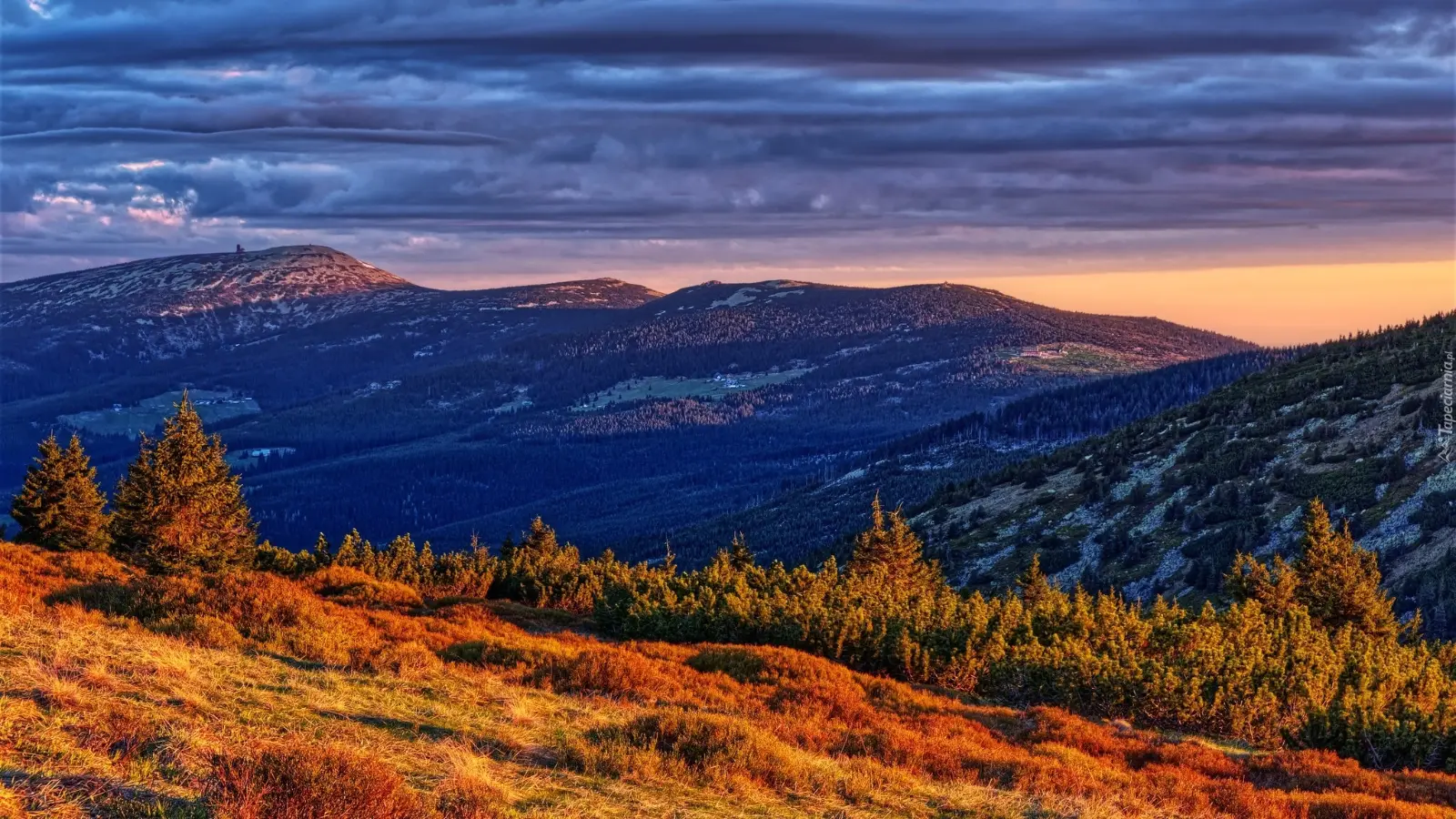
Karkonosze is the highest range of the Sudetes. Śnieżka, Snowy Cirques, stone labyrinths. Slow travel through Lower Silesia.
Why it's worth it
Karkonosze is the highest range of the Sudetes and one of the most interesting in Poland. It lies on the border with the Czech Republic, in the Lower Silesian voivodeship. The highest peak is Śnieżka (1,603 m) — the highest point in the Sudetes and one of the highest in Poland. Karkonosze has a distinctive landscape: granite crags, glacial cirques (Snowy Cirques, Łomniczka Cirque), stone labyrinths, peat bogs, and dwarf pine. These mountains look different from the Tatras — they are lower but wilder and less crowded.
Slow travel through Karkonosze is a journey through a landscape that demands effort. The mountains are not as steep as the Tatras, but the weather changes rapidly here — even in July snow can fall. It is worth spending 3–4 days here to truly feel this landscape. The best way to explore Karkonosze is on foot — there are about 100 km of hiking trails, including trails around Śnieżka. Public transport from Jelenia Góra and Karpacz is good (buses, trains).
What to see
Karkonosze is divided into three main parts: the Eastern Karkonosze (Śnieżka), the Western Karkonosze (Szrenica), and the Central Karkonosze (Snowy Cirques). Exploring the mountains takes 3–4 days.
Eastern Karkonosze
- Śnieżka — the highest peak in Karkonosze (1,603 m), with an observatory and chapel. Worth it for views.
- Łomniczka Cirque — a glacial cirque below Śnieżka, with a waterfall. Worth it for views.
- Karpacz — a small town at the foot of Śnieżka, with the wooden Wang church. Worth it for architecture.
Central Karkonosze
- Snowy Cirques — two glacial cirques, among the most beautiful in the Sudetes. Worth it for views.
- Szrenica — a peak above Szklarska Poręba (1,362 m). Worth it for views.
- Szklarska Poręba — a small town at the foot of Szrenica, with numerous guesthouses. Worth it as a base.
Western Karkonosze
- Kamieńczyk waterfall — the highest waterfall in the Sudetes (27 m). Worth it for views.
- Chojnik — a castle on a rock, with a viewpoint. Worth it for architecture.
- Jelenia Góra — a town at the foot of Karkonosze, with a market square and monuments. Worth it for architecture.
When to go
- May and June — the best time for slow travel. Warm, green, fewer tourists. Beware of snow in higher sections.
- July–August — trail season. Worth it for peaks, but crowded in Karpacz and Szklarska Poręba.
- September–October — second best. Autumn colours, fewer people.
- November–April — Karkonosze in winter is accessible to experienced tourists. Worth it for skiers.
Getting there
- By car: ~1.5 hours from Wrocław (DK3), ~2 hours from Prague (D11), ~4 hours from Berlin (A4 + DK3).
- By train: Jelenia Góra, Karpacz, Szklarska Poręba have railway stations.
- By bus: PKS and private carriers from Wrocław and Jelenia Góra.
Karkonosze is best explored on foot — the mountains are well marked, and public transport from Jelenia Góra, Karpacz, and Szklarska Poręba is good.
How much time you need
A weekend (2 days) is the minimum — Śnieżka, Łomniczka Cirque.
Three days is realistic for a first visit. Śnieżka, Łomniczka Cirque, Szrenica, Snowy Cirques.
A week lets you explore all of Karkonosze — from Śnieżka to Szrenica, with numerous stops.
What to eat and where to sleep
- Kwaśnica — sour cabbage soup, a Lower Silesian classic.
- Pierogi with meat — a Lower Silesian classic, available at inns.
- Trout from the Kamienna — from local farms, available at inns.
- Beer from Lower Silesian breweries — several craft breweries in the region.
Accommodation: Jelenia Góra (town, more options), Karpacz (small town, more options), Szklarska Poręba (small town, more options), Ścięgny (village, agritourism).
Practical tips
- Guided tours — Karkonosze is demanding, take a guide on harder trails.
- Weather — Karkonosze weather changes rapidly. Check the forecast before setting out and bring a rain jacket.
- Shopping — buy honey, cheese, and cold cuts directly from farmers.
- Tickets — park entry tickets are mandatory. Buy online in advance.
- Safety — do not attempt high-mountain trails without experience. Consider travel insurance.
- Signal — weak in higher sections. Have an offline map.