
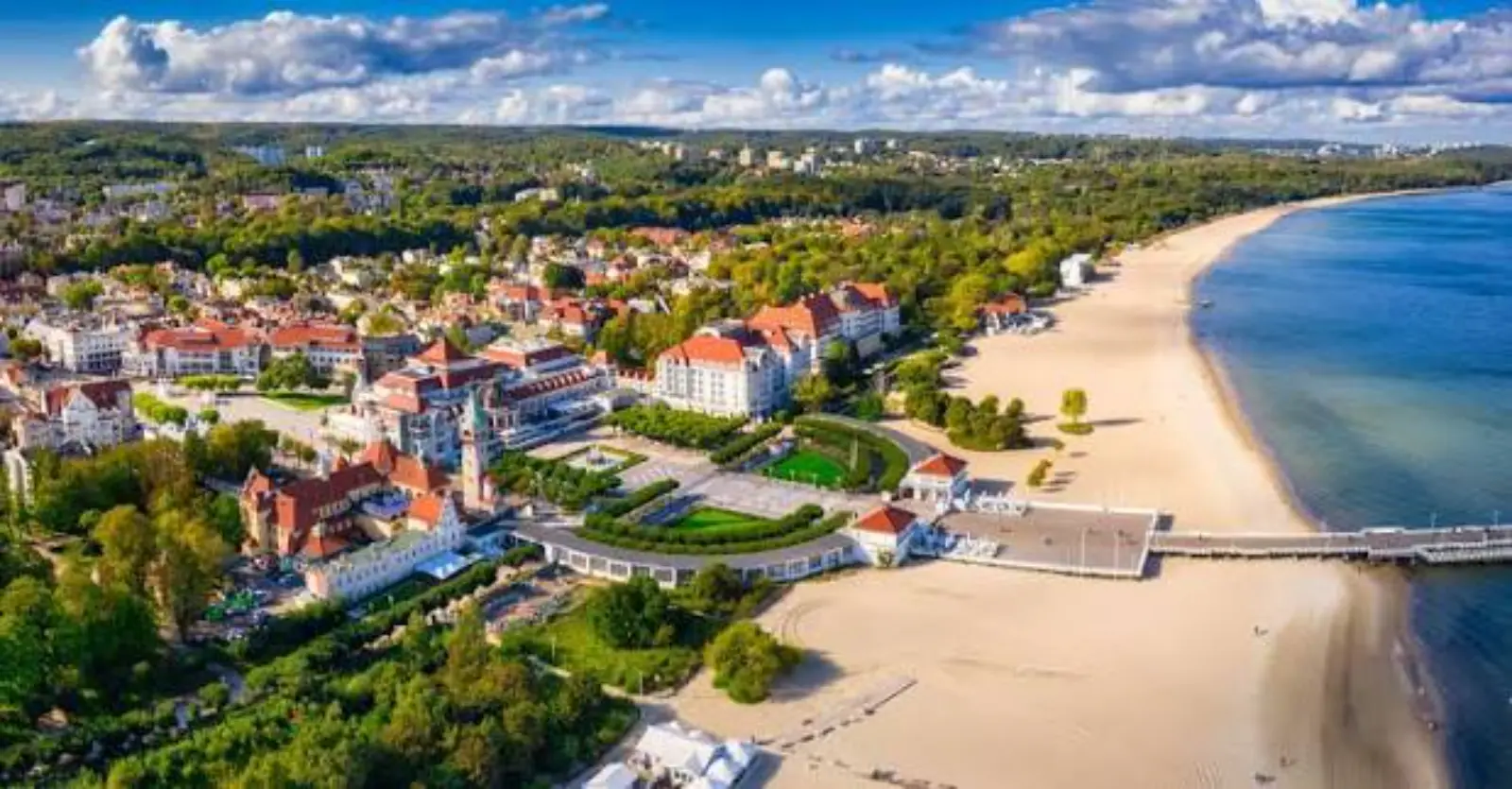
Sandy beaches, wide promenades, and sea air that always works wonders for a quick reset. Slow travel through Sopot — a city to know beyond Monciak.
Why Sopot, differently
Sopot is a city that can be both a vibrant resort and an oasis of calm. The key to discovering its second face is giving up haste and stepping off the main promenade. Monciak (Bohaterów Monte Cassino street) is Sopot's showcase — but the true beauty of the city hides in the side streets, in the Świemirowska Valley, on the cliffs towards Orłowo.
Slow travel through Sopot is a celebration of the sea. Instead of racing from attraction to attraction, it is worth sitting on the beach, listening to the waves, drinking coffee in a seaside café. This is a city that rewards those who slow down — even in peak season, when crowds walk Monciak, the beach at dawn is empty and belongs only to you.
What to see
Sopot splits into three parts: the centre (with Monciak and the Pier), Lower Sopot (beach, park) and Upper Sopot (villa districts, Świemirowska Valley). One to two days are enough to see it, but for a longer stay it is worth combining Sopot with Gdańsk and Gdynia.
Centre and Monciak
- Sopot Pier — the longest wooden pier in Europe (511.5 m). Worth walking it at dawn or in the evening — the view over the Gulf of Gdańsk and the panorama of the Tricity takes your breath away. Paid entry off-season, free in July and August.
- Bohaterów Monte Cassino Street (Monciak) — the main promenade of Sopot, full of cafés, restaurants and shops. Worth walking once, but not treating as a goal in itself. Side streets are more interesting.
- Crooked House — a distinctive building on Monciak, designed by Szotyńscy and Zaleski. It looks as if it was drawn by a fairy-tale illustrator. Today a shopping centre.
- Church of the Saviour — a Neo-Gothic temple from the 19th century, one of the most important monuments of Sopot. Worth noting the tower and stained glass windows.
- Forest Opera — an amphitheatre in the Northern Park, venue of music festivals (Sopot Festival, Sopot Top of the Top). Concerts have been held here since 1909.
Beach, park and Świemirowska Valley
- Sopot Beach — wide, sandy, with numerous entrances. Lifeguarded in summer. Worth looking for less crowded sections — for example east of the pier, towards Gdańsk.
- Northern Park — one of the most beautiful parks in the Tricity, surrounding the Forest Opera. Alleys, ponds, old trees. Perfect for a walk after the beach.
- Southern Park — smaller, closer to the centre. Worth combining with a visit to the beach.
- Świemirowska Valley — a forest in the middle of Sopot, with a stream and walking paths. Less known but very interesting. Worth a walk on hot days — it is always cooler in the forest.
- Cliffs towards Orłowo — a walking trail along the cliff, towards Gdynia-Orłowo (~5 km). Easy route, breathtaking views. Worth walking at sunset.
Museums and lesser-known corners
- Museum of Sopot — history of the city, especially the interwar period and the casino's activity. Worth it for understanding Sopot's identity.
- Sopot Lighthouse — smaller than the lighthouses in Gdańsk and Hel, but with an interesting history. Worth seeing from the outside.
- Agnieszka Osiecka Bench — on Monciak, with a sculpture of the poet. A popular meeting spot.
- Kamienny Potok and Kolibki — districts on the outskirts of Sopot, quiet, with villas and greenery. Worth it for those seeking silence.
- Sopot Aquapark — for families with children, a complex of pools and slides. A good plan B on rainy days.
When to go
- May and June — the best time. Beaches empty, prices lower, long days. Weather can be capricious, but evenings stay light until 10 p.m.
- September and October — second best. Warm sea, fewer crowds, golden colours in the parks.
- July and August — peak season. Monciak crowded, prices high, beaches full. But this is festival time (Sopot Festival, Top of the Top) and the warmest water.
- November and December — Sopot in winter can be harsh, but parks and beaches look fairy-tale. Lowest prices of the year.
- Winter — for those who want to see the sea without crowds. Bring warm clothes — it is windy by the sea.
Getting there
- By train: Sopot has an SKM and PKP station, with direct connections from Gdańsk (~20 min), Gdynia (~15 min), and also from Warsaw (~3.5 hours), Kraków (~6 hours).
- By car: ~20 minutes from Gdańsk (DK468), ~20 minutes from Gdynia (DW468), ~4 hours from Warsaw (S7). In season, access roads to Sopot can be crowded — better to come by train.
- By bus: Flixbus and other operators serve most Polish cities.
- By plane: Gdańsk airport (GDN), ~20 km from Sopot. From the airport by SKM train (~30 min).
Within Sopot, the centre is compact and most sights are within walking distance. The SKM (Fast Urban Railway) connects Sopot with Gdańsk and Gdynia — services every 10–20 min.
How much time you need
A weekend (1–2 days) is the minimum — Pier, Monciak, beach and a walk along the cliffs towards Orłowo. Enough for a first impression.
Three days is realistic for a first visit. One day for Sopot (Pier, Monciak, beach), one day for Gdańsk (Old Town, Oliwa), one day for Gdynia (Kościuszko Square, Kamienna Góra).
A week lets you explore the whole Tricity and surroundings — Sopot, Gdańsk, Gdynia, Hel, Sobieszewo Island, and even Malbork.
What to eat and where to sleep
- Baltic fish — herring, flounder, cod, smoked salmon. Best in small fry shops by the beach.
- Herring in oil — a coastal cuisine classic. Variants with onion, sour cream, mustard.
- Kashubian cuisine — in the Gdańsk region, try ruchanki, kiszka z kaszy i krwi, goose soup.
- Buckwheat pierogi — a variant popular in Pomerania, less known in the rest of Poland.
- Craft beer — Sopot has several good craft breweries.
- Specialty coffee — the coffee scene in Sopot is decent, especially in the side streets off Monciak.
Accommodation: Sopot centre (most convenient, but expensive and noisy on weekends), Lower Sopot (close to the beach, quieter), Upper Sopot (villa districts, quiet), Forest Opera area (close to the park, quiet). Sopot has several good boutique hotels in restored villas — worth considering for the atmosphere.
Practical tips
- Bookings — hotels and restaurants in season (July–August) must be booked 2–3 weeks in advance. Other months — on the spot.
- Pier — paid entry off-season, free in July and August. Worth going at dawn or in the evening — fewer crowds.
- Beach — lifeguarded in summer. Worth looking for less crowded sections — east of the pier, towards Gdańsk.
- Cliffs towards Orłowo — easy route (~5 km), but watch out for the cliffs — do not approach too close to the edge.
- SKM — buy tickets via app (e.g. SkyCash) or at station machines. A 24h ticket works on all transport in the Tricity.
- Crowds — Monciak and the Pier are crowded from May to September. Rise early and start sightseeing before the crowds.
- Parking — the centre has a paid parking zone. Large car parks near the Forest Opera. Leave the car and walk or take the SKM.