
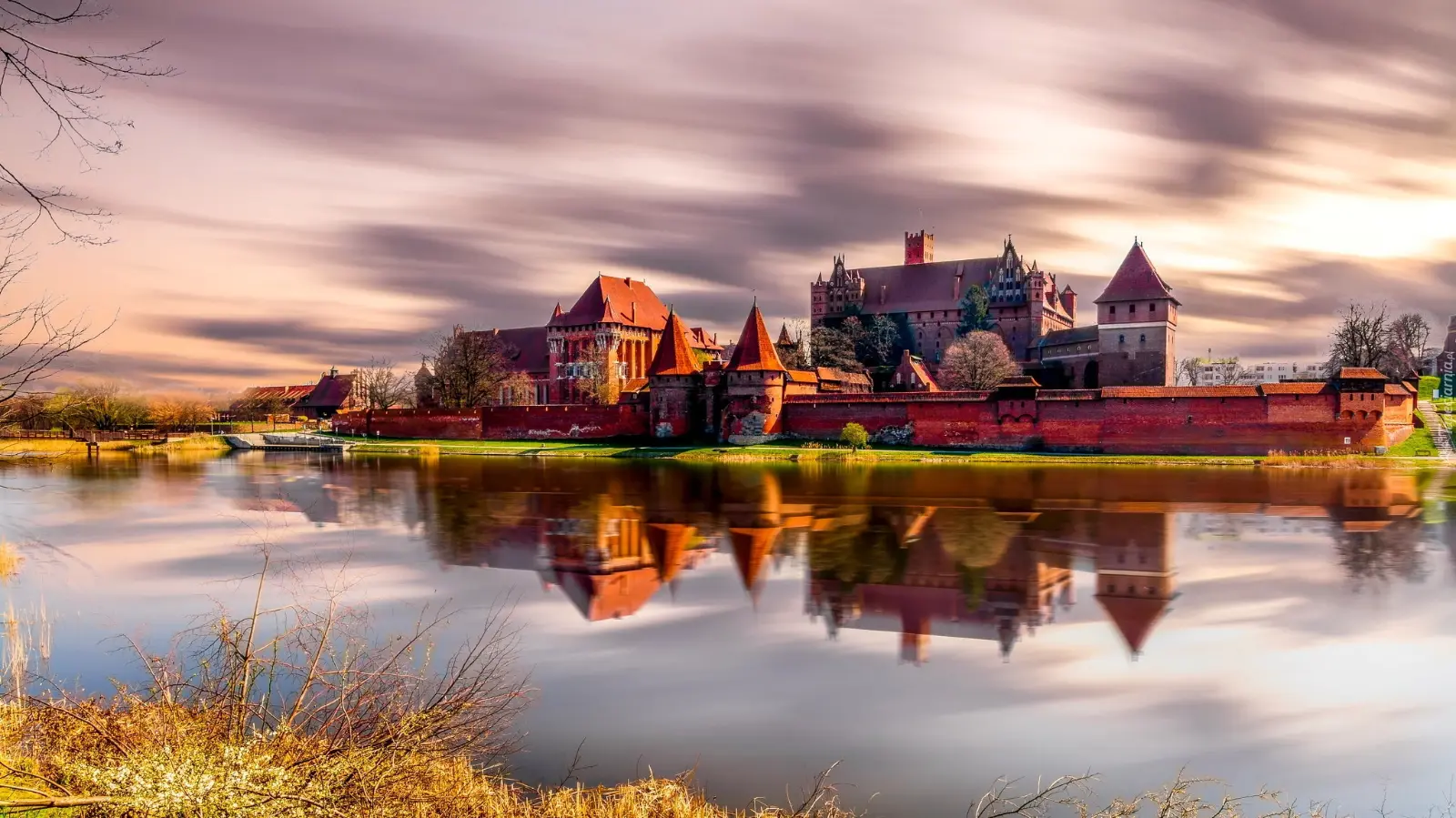
A Gothic fortress on the Nogat, built over 200 years. Slow travel through Malbork — a place where the history of the Teutonic Order is present in every brick.
Why Malbork, differently
Malbork is not just the largest brick castle in the world — it is above all a place where the history of the Teutonic Order was permanently written into every wall, every brick, and every vault. The castle covers 21 hectares, and its construction took over 200 years (from 1274 to 1457). This is not a place you can see in two hours.
Slow travel through Malbork means giving up haste. Instead of rushing through all the exhibitions, it is worth choosing two or three rooms and giving them full attention. The High Castle, the Great Refectory, the Palace of the Grand Masters — all these places are best visited outside the busiest hours, early in the morning or late in the afternoon, when only your own footsteps and the echo bouncing off brick walls can be heard in the cloisters.
What to see
Malbork Castle splits into three main parts: the High Castle (oldest, most important), the Middle Castle (with the Great Refectory and the Palace of the Grand Masters) and the Low Castle (the Outer Bailey, formerly economic). Visiting all three takes 4–6 hours.
High Castle
- Church of Our Lady — a Gothic temple in the heart of the High Castle, with colorful vaults and star ribbing. Today a venue for concerts and cultural events.
- Chapter House — the meeting room of the Order's chapter, with preserved 14th-century decoration. Note the palm vault.
- Convent Refectory — the largest room in the High Castle, where the monks ate. Today, amber and medieval art collections are displayed here.
- Kitchen and cellars — a 14th-century underfloor heating system (hypocaustum), one of the oldest in Europe. Worth seeing how such a huge castle was heated.
Middle Castle
- Great Refectory — a ceremonial hall where guests were received. Star vault, granite pillars, enormous space. This is where the Order's greatest feasts were held.
- Palace of the Grand Masters — the residence of the Grand Masters, built in the 15th century in English Gothic style. The interiors delight with lightness and space — they do not resemble typical defensive castles.
- Summer Refectory — a smaller hall with a view over the Nogat. Today an exhibition of Gothic art from the region.
- Treasury — the Order's former treasury, today an exhibition of jewelry and liturgical objects.
Low Castle and Outer Bailey
- Karwan — former arsenal, today an exhibition of weapons and armament from various eras.
- Mill and bakery — the castle's former economic infrastructure. Worth seeing how this enormous fortress functioned.
- Bridge Gate — the main entrance to the castle, one of the best-preserved Gothic gates in Poland.
- Defensive walls and towers — the castle's defensive system was one of the most modern in Europe in the 15th century. Worth walking along the walls and seeing how it worked.
Evening illumination and surroundings
- Castle illumination — in the evening the castle is illuminated, creating an unforgettable view against the sky. Worth walking along the Nogat as the brick walls reflect in the river.
- Castle park — green areas around the castle, perfect for a walk after sightseeing. Alleys, benches, viewpoints.
- Bridge over the Nogat — one of the most beautiful viewpoints of the castle. Worth crossing to the other side of the river and seeing the panorama from a distance.
When to go
- May and June — the best time. Fewer crowds, long days, stable weather. The chambers are not overheated.
- September — second best. Warm days, fewer tourists, good light for photos.
- July and August — peak season. Castle crowded, queues at ticket offices, but all exhibitions open and numerous cultural events.
- October and November — fewer tourists, but some exhibitions may be closed for winter. Check opening hours.
- Winter — the castle under snow looks fairy-tale, but touring is shorter and less comfortable. Bring warm clothes.
Avoid May long weekends and public holidays — the castle bursts at the seams.
Getting there
- By train: Malbork has a railway station on the Gdańsk–Warsaw line, with direct connections from Gdańsk (~40 minutes), Warsaw (~3 hours), Olsztyn (~1.5 hours).
- By car: ~50 minutes from Gdańsk (S7), ~3.5 hours from Warsaw (S7), ~1.5 hours from Olsztyn (DK51).
- By bus: PKS and private operators from Gdańsk and other cities in the region.
The railway station is ~1 km from the castle — a 15-minute walk. You can also take a local bus or taxi.
How much time you need
Half a day (4–6 hours) is the minimum for visiting the castle. Add time for a walk around the grounds and lunch in one of Malbork's restaurants.
A full day lets you tour with a guide at leisure, walk along the Nogat and see the evening illumination.
A weekend (2 days) lets you add other attractions of the region — Szymbark Castle, Frombork, Elbląg or the Baltic coast.
What to eat and where to sleep
- Fish from the Vistula Lagoon — eel, pike-perch, bream. Available in restaurants in Malbork.
- Pomeranian duck — roast duck with apples and marjoram, a Pomeranian classic.
- Buckwheat pierogi — a variant popular in Pomerania, less known in the rest of Poland.
- Potato sausage (kiszka ziemniaczana) — a traditional rural dish.
- Beer from a local brewery — Malbork has a craft brewery (Browar Zamkowy).
- Coffee and cake — the centre of Malbork has several good cafés, ideal for an afternoon break.
Accommodation: Malbork (several hotels, guesthouses and hostels in the centre, close to the castle), Gdańsk (~50 km, more options, but further), Elbląg (~30 km, good base). In season, book ahead, especially on weekends.
Practical tips
- Bookings — castle tickets are worth booking online in season (zamek-malbork.pl). In July and August queues at ticket offices are long, and the number of places for guided tours is limited.
- Guided tours — the castle's history is complex, and without context many rooms look similar. Worth going with a guide or audio guide.
- Combined ticket — covers all three castles (High, Middle, Low). Worth buying at once — individual tickets are more expensive.
- Night tickets — the castle offers special night tours on selected days. Check the schedule online.
- Shoes — touring involves a lot of walking on uneven surfaces. Comfortable shoes are essential.
- Water — there are drinking water points in the castle, but bring your own bottle.
- Signal — good throughout the city, including the castle.
- Parking — large car park at the castle, paid in season. Arrive early to get a good spot.