Sanok is the gateway to the Bieszczady and one of the oldest cities in Poland. Open-air museum, icons, castle. Slow travel through the Subcarpathian region.
Why it's worth it
Sanok is a city in the Subcarpathian voivodeship, on the San river, at the foot of the Bieszczady. It is one of the oldest cities in Poland — it received city rights in 1339, but settlement here dates back to the early Middle Ages. Sanok is a city that has everything a city on the border of cultures should have: a castle, an open-air museum, Orthodox churches, Roman Catholic churches, a synagogue, and museums. Add to that unique cultural heritage: the Historical Museum in Sanok with the largest collection of icons in Poland, the Museum of Folk Architecture (open-air museum), and works by Zdzisław Beksiński — one of the most outstanding Polish contemporary painters.
Slow travel through Sanok is a journey through a landscape that surprises with its diversity. The city has a castle, an open-air museum, museums, and Orthodox churches — all within a few kilometres. It is worth spending 2–3 days here to truly feel this landscape. The best way to explore Sanok is on foot, and the Bieszczady by car — public transport from Rzeszów and Kraków is good (trains, buses).
What to see
Sanok is divided into three main parts: the centre (Market Square and castle), the open-air museum (Museum of Folk Architecture), and the Bieszczady (surroundings). Exploring the city and surroundings takes 2–3 days.
Centre
- Market Square — the main square of the city, with townhouses and a town hall. Worth it for architecture.
- Royal Castle — a 14th-century castle, now home to the Historical Museum. Worth it for architecture.
- Historical Museum — a museum with the largest collection of icons in Poland (about 700). Worth it for culture.
Open-air museum
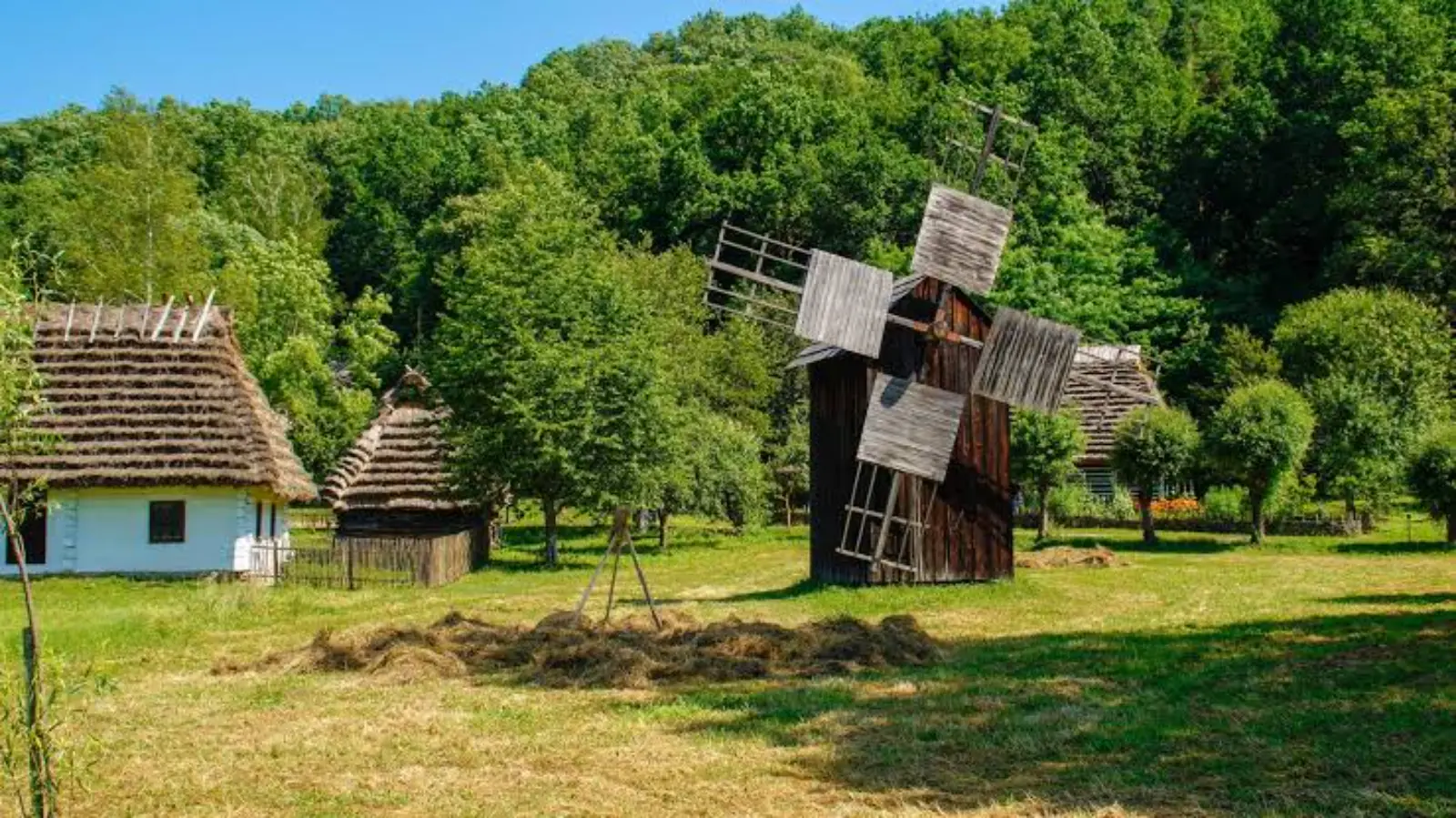
- Museum of Folk Architecture — one of the largest open-air museums in Poland, with buildings of the Pogórzanie, Lemkos, and Boykos. Worth it for culture.
- Open-air Orthodox churches — several Orthodox churches moved to the museum from the area. Worth it for architecture.
- Farmsteads — numerous peasant farmsteads from the 19th and 20th centuries. Worth it for culture.
Bieszczady
- Bieszczady — mountains south of Sanok, among the wildest in Poland. Worth it for hiking.
- Solina — a reservoir lake in the Bieszczady, with numerous harbours. Worth it for sailing.
- Lesko — a small town with a synagogue and castle, on the way to the Bieszczady. Worth it for architecture.
When to go
- May and June — the best time for slow travel. Warm, green, few tourists.
- July–August — Bieszczady and open-air museum season. Worth it for hiking, but crowded in Solina.
- September–October — second best. Autumn colours, fewer people, mushroom picking in the forests.
- November–March — the city is sleepy in winter, but museums are open. Worth it for those seeking silence.
Getting there
- By car: ~1.5 hours from Rzeszów (DK28), ~3.5 hours from Kraków (DK28), ~5.5 hours from Warsaw (S7 + DK28).
- By train: Sanok has a railway station, with connections from Kraków and Rzeszów.
- By bus: PKS serves Sanok, Lesko, Ustrzyki Dolne, Solina.
Sanok is best explored on foot — the city is small, and attractions are close together. The Bieszczady is best explored by car or on foot.
How much time you need
A weekend (2 days) is the minimum — Market Square, Castle, Open-air museum.
Three days is realistic for a first visit. Market Square, Castle, Open-air museum, Historical Museum, Bieszczady.
A week lets you explore all of Sanok and the Bieszczady — from Lesko to Ustrzyki Dolne.
What to eat and where to sleep
- Pierogi with bryndza — regional pierogi with sheep cheese, available at inns.
- Proziaki — flatbreads of flour and sour milk, served with butter or lard.
- Trout from the San — from local farms, available at inns.
- Goat cheeses — from local farms, available in village shops.
- Beer from Subcarpathian breweries — several craft breweries in the region.
Accommodation: Sanok (city, more options), Lesko (small town, guesthouses), Solina (village, guesthouses), Ustrzyki Dolne (small town, guesthouses).
Practical tips
- Guided tours — Sanok's history is rich, take a guide at the castle and open-air museum.
- Icons — the Historical Museum has about 700 icons. Allow at least 2 hours for them.
- Shopping — buy honey, cheese, and cold cuts directly from farmers.
- Open-air museum — in season, craft demonstrations and folklore events take place. Check the calendar.
- Weather — Bieszczady weather can be changeable, even in July bring a jacket.
- Signal — good in the city, weaker in the Bieszczady. Have an offline map.